Event
Plotting Poetry 8
Plotting Poetry is a conference series focussed on computational, statistical and other quantitative approaches for the study of poetic texts, and of poeticity more broadly.
This quantitative focus, this insistence on the formalization and operationalisation of texts, from simple pen and paper counting and compiling to complex algorithms, provides us with a number of paths to analyze, describe, interpret, attribute, classify, track and generally access the texts. The Plotting Poetry conferences bring together a friendly community of researchers, and articles rooted in the conference papers have given rise to several peer-reviewed collective volumes.
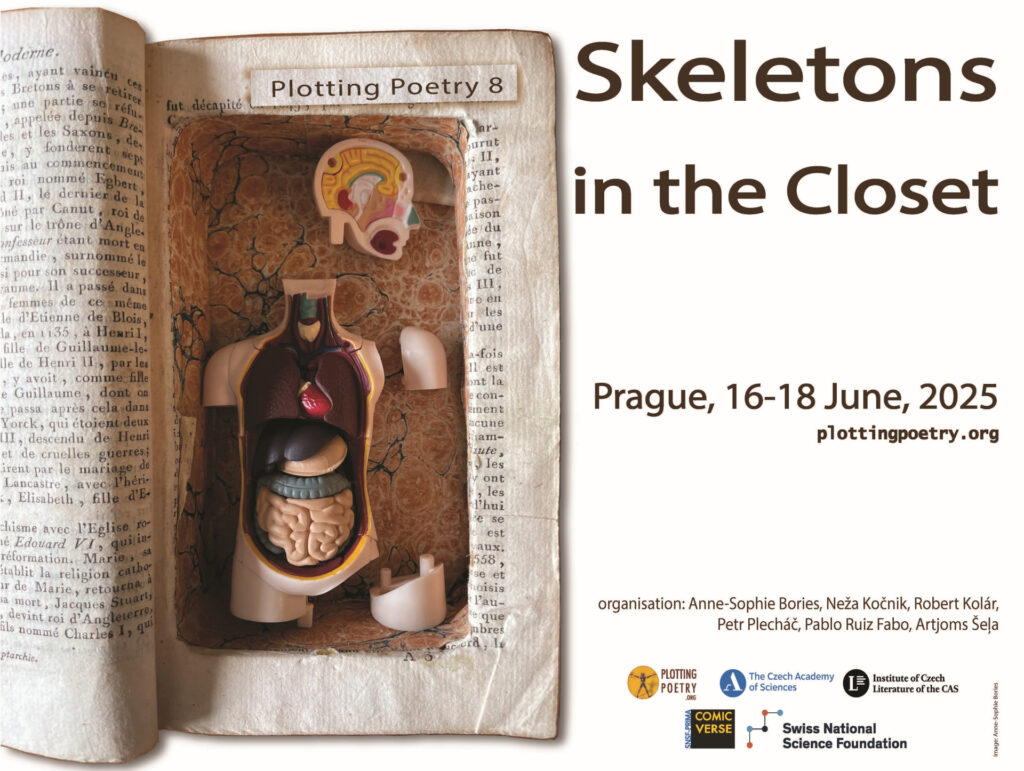
This year the conference’s theme is skeletons in the closet: everything hidden and peculiar in poetry that stands out, makes one uneasy, or does not fit common theoretical and historical narratives. We welcome all kinds of scholarship about outliers, unexpected and misunderstood phenomena, formal and conceptual transgressions. We encourage presenting negative and confusing results, methodological hurdles and mistakes that were recognized too late.
Poetry itself is a skeleton in a closet: a speech shifted away from the norm that makes language anew, in an often overly intimate process, hidden from the public's prying eye. It is almost a criminal act: fitting words into a metrical pattern is like fitting a corpse in a cabinet. Poetry is impulsive, but measured, driven by rules, but creating uncertainty, valuable, but not a commodity. In short, poetry is an outlier.
The event is organized by the Institute of Czech Literature of the Academy of Sciences of the Czech Republic and the University of Basel.
Information
See also
Scraps... Reading Residuality
In colloquial English crap is “nonsense, rubbish”; crappy is “rubbishy” or “disgusting”. Crap is “faeces”, with the verb “to crap” meaning “to defecate”. It is this far more common use of the word crap that the audience cannot fall to bring to mind in relation to the play. All the associations merge in this overriding definition of crap as excrement and waste. The tapes that Krapp has accumulated during his lifetime, are these all just waste, just crap? The “memorable equinox” about which the thirty-nine-year-old Krapp is so enthusiastic, is this just rubbish, meaningless, crap?
Quest for Form. The international conference of the series "Poetry Translation – Negotiating of Imagination"
In 2012 the discussion was opened with quest and negotiation of poetry articulated in various
Vladimir Nabokov and the Fictions of Memory
Almost 40 years after Nabokov's death his texts continue to function as literary Fabergé eggs in which scholars keep finding hidden surprises and previously overlooked details. As Nabokov wrote in Conclusive Evidence, "the unravelling of a riddle is the purest and most basic act of the human mind." However, readers and critics are divided on the issue of whether Nabokov is a postmodern riddle-maker enjoying the game itself without enabling the player to reach the ultimate solution, or whether the riddles are solvable by a reader astute enough to follow all the sophisticated patterns and allusions which point to Nabokov's metaphysical convictions.
The Quest for Transcendence / an international conference in the series "Poetry Translation – Negotiating Imagination"
The Department of Transcultural Literary Studies is honoured to invite you to the international conference Poetry Translation - The Quest for Transcendence, which is a continuation of reflection on the problem of poetry translation undertaken by us in 2012 and 2016.