Event
International Scientific Conference NARRATIVE ATOMS The Persistence and Transformation of Fundamental Story Units in Culture
The conference is devoted to the durability and transformation of the elementary narrative structures that have organized human experience and modes of storytelling for centuries. We are interested in the basic, culturally recognizable matrices of meaning—from forms rooted in oral tradition, to their contemporary counterparts functioning in digital environments.
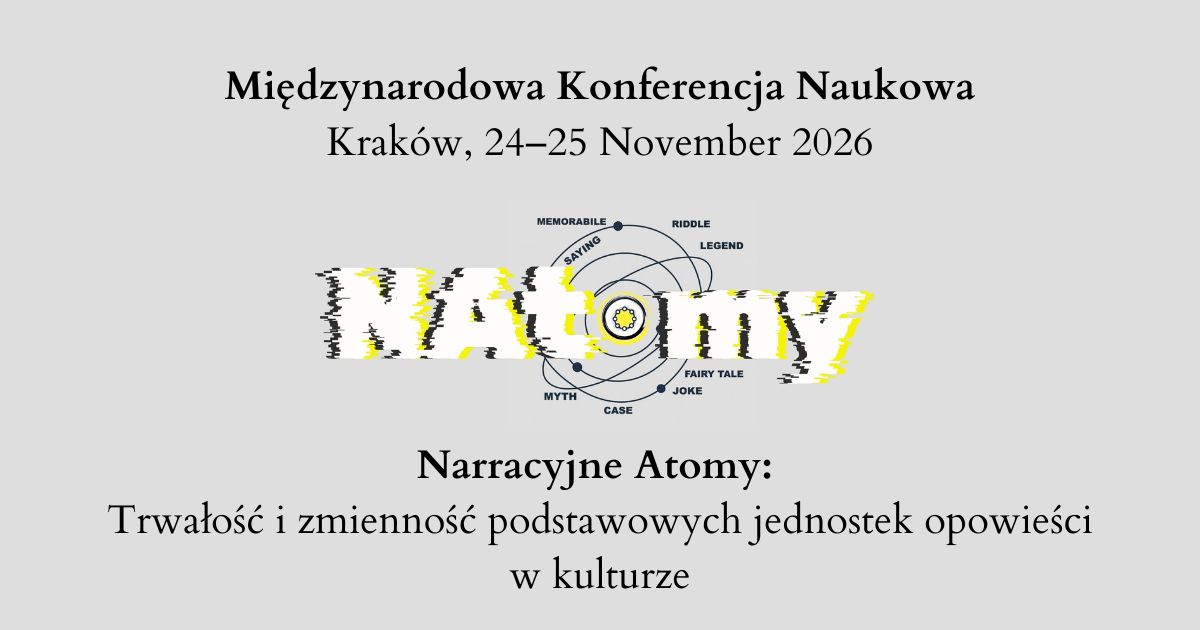
Our reflections on these structures draw on a broad theoretical context, including research on narrative typology, compositional dynamics, and minimal units of meaning. This field encompasses both classical work in the morphology of narrative and narratology, as well as theories that examine the semantic foundations of storytelling. These methodologies—ranging from folkloristic and structural analyses to contemporary studies of digital communication, as well as inquiries into historical and media narratives—emphasize the perpetual influence of elementary patterns on meaning. We are particularly interested in the current functions of fundamental narrative units across a variety of media, including journalism, prose, film, games, visual communication, and online discourse, from a contemporary cultural studies perspective. We focus on the profound transformations taking place in simple narrative forms in the digital environment, as well as on the enduring nature of these forms. We might ask ourselves whether forms such as the riddle, the case study, the proverb, the saga, the legend, or the myth retain their cognitive and integrative functions in new contexts. We propose an operational concept of ‘narrative atoms’, understood as minimal, repeatable matrices of meaning-making that operate across various traditions and media. We are interested in both their stability and their capacity for transformation, as well as in the processes through which elementary units give rise to complex narrative structures. At the heart of our research is the relationship between fundamental story units and the variable historical and technological architectures of meaning, from epics and novels to cinema, television series, and online, interactive narratives. Reflection on elementary narrative structures is a longstanding thread within the European humanities. Inspiring contributions include the ideas of Vladimir Propp, André Jolles, Roland Barthes, Paul Ricoeur, Gérard Genette, and Mieke Bal. From folkloristic research and the morphology of the tale, through structural analyses of genres, to contemporary narratology and media theory, the question continually returns: What are the minimal forms that organize meaning—those narrative units that structure experience, preserve memory, and enable the transmission of significance across different epochs and communicative environments? The search for elementary matrices of meaning—that is, "simple forms," as they are defined by Jolles—that function in oral and written culture is also a recurring theme in studies of oral composition. This approach finds a clear counterpart in the research conducted by Milman Parry and Albert Bates Lord, whose analysis of oral formulaic composition—presented, among other works, in "The Singer of Tales" (1960)—revealed the mechanism by which repetitive units generate epic structures. In this perspective, "elementariness" refers not only to the typology of forms but also to compositional dynamics: the manner in which narrative coherence emerges from recurring patterns. According to Jolles, pre-literary genres that functioned within oral culture, such as legend, saga, myth, riddle, saying, case, memorabile, fairy tale, joke, are not only elementary forms constituting tools for organizing experience (representations); they are also mechanisms of cultural transmission that enable individuals and communities to articulate their relationships with the world. Anna Wierzbicka's theory of the Natural Semantic Metalanguage (NSM) introduces a third dimension of contemplation on elementariness, which refines the notion of minimal units of meaning. The quest for semantic primitives—that is, the fundamental components of meaning—invites inquiry into the ontological underpinnings of narrative. The question arises as to whether elementary forms are predicated upon minimal semantic structures, which are indispensable for the possibility of storytelling. Conference Aim: The conference aims to create a space for transdisciplinary dialogue. We invite scholars from the fields of anthropology, literary studies, cultural studies, media studies, and related disciplines. Suggested Areas of Reflection: 1. Ontology and Theory of “Narrative Atoms.” • The epistemological status of fundamental narrative structures: universal or historically variable? • The persistence of archetypal patterns despite technological and medial changes. • Elementary narrative structures as models of knowledge organization and complexity reduction. • Hybridization and recontextualization of older patterns in late modern culture. • The relationship between elementary and complex narrative configurations. • The functioning of fundamental structures within extended narratives (novel, film, series, historiography). • Historical models of meaning-making as configurations of recurring narrative patterns. 2. Media and Digital Transformations: • Relations between orality, literacy, and digitality: continuities and ruptures. • Transformations of pre-literary narrative patterns in digital environments (memes, games, fan fiction, social media). • Elementary narrative units in cybertext, virtual literature, and immersive forms. • The presence of fundamental narrative patterns in visual narratives, such as art, film, television series, comics, and audiovisual forms. • Screen adaptations of myth, saga, and legend as examples of medial translocation. 3. Social and Cultural Functions: • Social and identity-forming functions of fundamental narrative patterns in contemporary digital culture. • Elementary structures as carriers of collective memory and cultural transmission. • Archetypal forms in historical narratives and historiography. • The presence of elementary narrative patterns in folk and popular culture. • The use of fundamental narrative structures in advertising, propaganda, and political communication. • Short expressive forms (jokes, proverbs, aphorisms) as tools for negotiating norms and symbolic orders. Form of Participation: Individual paper (20 minutes) Email address of the conference secretary: anna.folta@uj.edu.pl The registration form available via the link: Conference Registration Form – Wypełnij formularz Schedule and Fees: The conference fee is € 150.00/ PLN 500.00, and it is valid for all conference days. Submission of abstracts (papers): by 31 July 2026 (deadline) Notification of abstract acceptance: within 14 days of submission Fees and Accommodation: The conference fee includes catering services provided during the conference, specifically lunch and coffee breaks on both days of the event. The conference fee does not include accommodation. Upon request, the organizers may assist registered participants in identifying accommodation options. Publication process: Papers presented at the conference will be published in an international, peer-reviewed, English-language scientific monograph. Edited by the conference organizers, the volume will be published as a scholarly book devoted to the interdisciplinary study of narrative atoms and fundamental structures of meaning across media and cultural contexts. Each article must be submitted as an extended, revised version and undergo a double-blind peer review process. Final acceptance for publication depends on the reviewers’ recommendations and compliance with the volume's editorial standards. Detailed editorial guidelines and submission deadlines will be communicated to all participants after the conference. Organizers dr hab. Henryk Czubała, Media Studies Committee of the Polish Academy of Arts and Sciences dr Anna Folta-Rusin, Institute of Information Studies, Jagiellonian University Conference Secretary: dr Anna Folta-Rusin, Jagiellonian University anna.folta@uj.edu.pl Institutions: Institute of Information Studies, Jagiellonian University Media Studies Committee of the Polish Academy of Arts and Sciences Scientific Committee: dr hab. Henryk Czubała, Media Studies Committee of the Polish Academy of Arts and Sciences dr hab. prof. UJ Magdalena Wójcik, Institute of Information Studies, Jagiellonian University prof. dr hab. Maciej Kawka, Media Studies Committee of the Polish Academy of Arts and Sciences prof. dr hab. Maria Wojtak, Institute of Linguistics and Literary Studies, UMCS dr hab. prof. UJ Włodzimierz Próchnicki, Department of Polish Studies, Jagiellonian University dr Anna Folta-Rusin, Institute of Information Studies, Jagiellonian University dr Sabina Sanetra-Półgrabi, Institute of Journalism and International Relations, University of the National Education Commission, Krakow
Information
See also
Narratology Today – Contemporary Theories (and Practices) of Narrative
Department of Theory and Anthropology of Literature at the Institute of Polish Philology University of the National Education Commission, Krakow invites you to participate in the scientific conference Narratology Today – Contemporary Theories (and Practices) of Narrative which will take place on November 24-25, 2025. The sessions will be held in the main building of the University at Podchorążych 2 Street, Kraków, Poland
Expanding Universes. Exploring Transmedial & Transfictional Ways of World-Building
OVERVIEW It is no doubt that with the dynamic evolution of fantastic narratives a world-centered model of storytelling has started to proliferate, changing the way one can interact with fictional representations of worlds in literature, movies, video games, comic books, any other media. A growing interest in media-conscious world-building, both amongst scholars and fans, clearly shows that the future of narrative and media studies lays not with monomedial, but transmedial studies—especially when no-one seems to question cross-overs, retellings, remediations, or any other narrative devices so common in contemporary storytelling. From Star Wars Expanded Universe/Legends top-down and bottom-up transfictional storytelling or transmedial campaign for The Hunger Games the movie to multimodal storytelling in Doug Dorst’s “S” or Bioshock: Infinite“—we all engage in a plethora ways of world-making, and what transmedial narratology needs nowadays to do, is to analyze these storyworlds in their variety without imposing any paradigmatic world-building model for creators to follow. Consequently, organizers of the conference will welcome presentations or full panel proposals covering: • key and emerging concepts in transmedia studies and transmedial narratology; • theoretical discrepancies between transmediality, multimodality, and transfictionality; • theory, history, and philosophy of world-building in literature and other media; • top-down and bottom-up world-building and storytelling; ways of inhabiting fictional/virtual worlds: immersion, interactivity, and beyond; • franchises and franchised universes: their expansion and narrative potential; • fan & fandom studies with an emphasis on participatory authorship in shared universes, entertainment supersystems, and more; • means of narrative/economical control (i.e. canon, moderated/curated content, licencing etc.) in massive world-building enterprises; • psychological and philosophical contexts of world creation; • case studies of transmediality, transfictionality, and world-building across media (MCU, Game of Thrones, StarCitizen, Star Wars, DC Universe, and many more); KEYNOTE SPEAKER Confirmed conference keynote speaker is a prominent narrative theorist, Ma-rie-Laure Ryan, author of the most important books in possible worlds theory, hy-pertextuality, transmedia storytelling, transfictionality & multimodality, immersion theory, and narrative studies, such as Possible Worlds, Artificial Intelligence, and Narrative Theory (1991), Narrative as Virtual Reality: Immersion and Interactivity in Literature and Electronic Media (2001), Avatars of Story (2006), or (co-edited), Narrative Across Media: The Languages of Storytelling (2004) or Storyworlds Across Media. Toward Media-Conscious Narratology (2015). REGISTRATION, SUBMISSIONS & FEES The conference language is English. To register for the conference, one should sent in editable format (.doc, .docx.) 600-words abstracts featuring (1) the title of presentation, (2) a concise bio-note, (3) current affiliation, and (4) all necessary con-tact information (official email address & phone num-ber) at transmedialstudies@gmail.com by June 30th 2016. Successful applicants will be notified within two weeks after the deadline. Attendees are also encouraged to send us full panel proposals composed of (1) abstracts from a minimum number of 4 delegates, (2) up to 600 words description of the panel, (3) a suggested title of the panel and, most importantly, (4) email addresses of all delegates included in the proposed panel. The conference fee of 100€ will cover conference materials, catering and all other essentials, but does not include accommodation. MORE INFO Further details regarding the venue, suggested accommodation and transporta-tion will be continuously updated at the websitetransmedialstudies.wordpress.com. Organisers do welcome all questions and requests at transmedialstudies@gmail.com. The conference will be followed by a peer-reviewed monograph, published by Fac-ta Ficta Research Centre and licenced under Creative Commons 4.0 as an ebook stored in a globally accessible repository (CeON Center for Open Science) and / or in peer-reviewed special editions of renowned scholarly journals. We look forward to seeing you in Kraków! THE ORGANISING COMMITTEE Ksenia Olkusz, PhD (Facta Ficta Research Centre in Kraków) Piotr Kubiński, PhD (University of Warsaw) Krzysztof M. Maj (Jagiellonian University, Facta Ficta Research Centre in Kraków) - project co-ordinator Sven Dwulecki (Eberhard Karls University Tübingen)
The Bourgeois Public Discusses Art III: Transnational Media, Mediators and Art Practices in Central Europe
This workshop seeks to explore the intricate relationship between the bourgeois public (Reinhart Koselleck, Jürgen Habermas) and literature and the arts, with a particular focus on the transnational role of the media, mediators and art practices in Central Europe from the late 18th century until the end of the 19th century.
Between clarity and fuzziness.Investigating the concept of meaning in linguistic, literary and philosophical contexts / 5th Annual Siedlce Forum for Contemporary Issues in Language and Culture
Siedlce University of Natural Sciences and Humanities - Institute of Linguistics and Literary Studies and Universitat de les Illes Balears - Faculty of Philosophy and Art would like to kindly invite all scholars representing different philological disciplines and theoretical models to 5th Annual Siedlce Forum for Contemporary Issues in Language and Literature to be held online on November 27th, 2020 to present their research findings (not previously published or presented) in oral sessions in English. The conference will be a virtual event.