Nowość wydawnicza
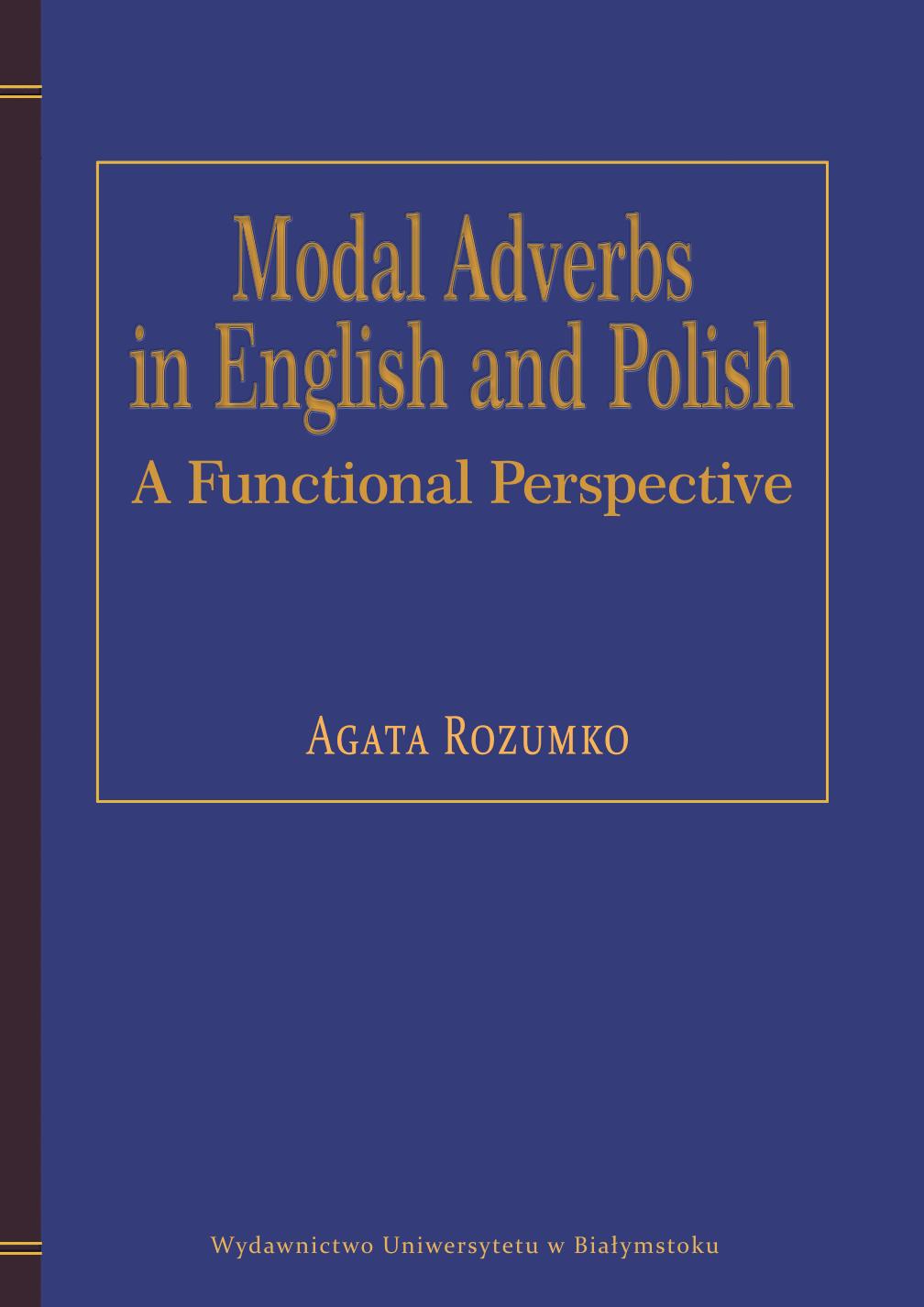
Modal Adverbs in English and Polish
Kategoria: FILOLOGIE OBCE
Autorzy: AGATA ROZUMKO
Rok wydania: 2019
Numer ISBN: 978-83-7431-559-3
Liczba stron: 592
Format: B5, oprawa twarda
This book offers a contrastive, corpus-illustrated study of modal adverbs in English and Polish. It adopts a functional perspective on modal adverbs, and focuses on their interpersonal, textual, and rhetorical functions in the two languages. The items under analysis (e.g. certainly, probably, evidently, clearly) are categorised differently in Anglophone and Polish linguistics, which is why this book also provides some insights into the treatment of modality and modal adverbs in English and Polish studies, thus contributing to the discussion of the ways in which such concepts as modal adverb, modal particle, and discourse marker are understood across different languages and different linguistic traditions. It draws its examples from two monolingual corpora (the British National Corpus and the National Corpus of Polish), and the English-Polish parallel corpus Paralela.
Informacje

Zobacz także
Grzegorz Moroz,A Generic History of Travel Writing in Anglophone and Polish Literature.Series:Textxet: Studies in Comparative Literature, Volume: 93
Autor/Redaktor:
A Generic History of Travel Writing in Anglophone and Polish Literature offers a comprehensive, comparative and generic analysis of developments of travel writing in Anglophone and Polish literature from the Late Medieval Period to the twenty-first century. These developments are depicted in a wider context of travel narratives written in other European languages. Grzegorz Moroz convincingly argues that, for all the similarities and cross-cultural influences, in the course of the nineteenth and twentieth century non-fiction Anglophone and Polish travel writing have dynamically evolved different generic horizons of expectations. While the Anglophone travel book developed relatively steadily in that period, the Polish genre of the podróż was first replaced by the listy (kartki) z podróży, and then by the reportaż podróżniczy.
A Generic History of Travel Writing in Anglophone and Polish Literature
Autor/Redaktor:
E-Book (PDF) Availability: Published ISBN: 978-90-04-42961-1 Publication Date: 31 Aug 2020 Hardback Availability: Published ISBN: 978-90-04-42959-8 Publication Date: 03 Sep 2020
Anti-Jesuit Discourse in the Polish–Lithuanian Commonwealth (1576–1632). Arguments, Tropes, Figures
Autor/Redaktor:
W Wydawnictwie Brill (w serii Brill Research Perspectives in Jesuit Studies) ukazała się nowa książka pracownika Katedry Komparatystyki Literackiej Wydziału Polonistyki UJ, Wojciecha Ryczka pt. Anti-Jesuit Discourse in the Polish–Lithuanian Commonwealth (1576–1632). Arguments, Tropes, Figures. Książka w wolnym dostępie na stronie wydawnictwa Anti-Jesuit Discourse in the Polish–Lithuanian Commonwealth (1576–1632) – Arguments, Tropes, Figures | Brill
The Staszic Palace as Affective Heterotopia: New Category of Spatial Description
Autor/Redaktor: Aleksandra Wójtowicz
The book proposes a new category – heterotopia of affect – which builds upon Michel Foucault’s typology. The category refers to changes of the places that accumulate contents of ideological, historical, religious, and national character. The book tells the history of a very Polish edifice as well as its surrounding cultural milieu and the history-creating role of the scientific community. The author focuses on the Staszic Palace whose fate reveals how – at different times in history – it catalyzed activities in search of radical changes in the mental landscape of the Polish community.