Artykuł / wywiad
Towards Architectural Humanities
Aleksandra Wójtowicz talks to Krystyna Ilmurzyńska, Włodzimierz Pessel and Andrzej Skalimowski.
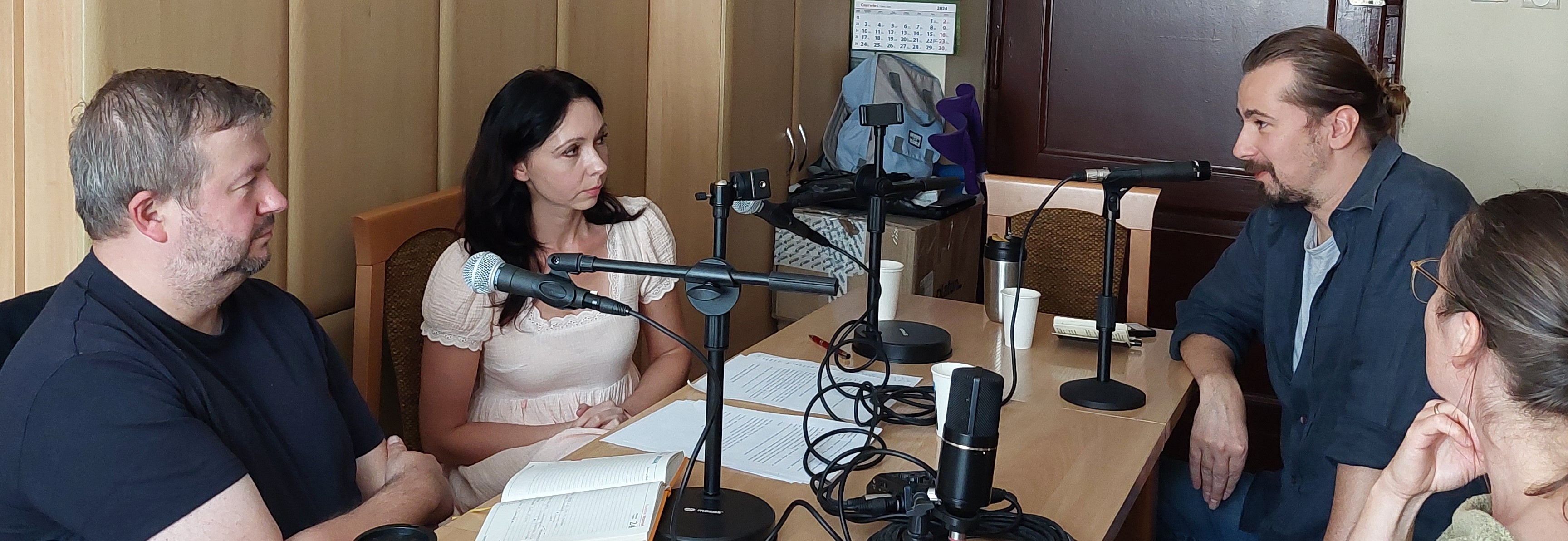
Aleksandra Wójtowicz: We are meeting to discuss issues related to one of the thematic circles around which the work of the project Polish Studies in the Face of the Challenges of the Contemporary World focuses, which is architectural literary studies. However, I would like to treat it as a starting point for a broader talk on the perspectives of various disciplines belonging to both the humanities and engineering and technical sciences, which offer research works supporting the process of designing and managing urban space.
Architectural literary studies is a goal-oriented approach, where a literary scholar examining the relations between space and society through the prism of textual records can offer the results of their research to decision-making bodies, architects, urban planners - the sectors responsible for transforming, analyzing and creating space in both its physical and, which is very important, cultural dimensions. It employs various research methods in the field of cultural studies of space, but the work is conducted in response to specific social needs, thus contributing to the science policy which aims to ensure the social impact of humanities research.
How do architects, who are agents in the physical space, view the issue of the relationship between real and imagined space? Is there room in the design process to take into account the sphere of emotions and impressions? And is there room to build upon textual materials?
Krystyna Ilmurzyńska: I would start by saying that architects operate with imagined space, because the real agents are those who build or have financial or political power over what is being built.
It seems to me that an important, although perhaps slightly overlooked, aspect is this core of non-rational creativity in design. The sphere of personal sensitivity and feelings is something inevitable. Design theoretically results from very pragmatic motives, because it is conditioned by formal, financial and technical issues. Nevertheless, the way in which we solve problems results from our direction of thinking and our view of the world. The key is to absorb possible points of view, metaphors, including those taken from literature. I believe that literature, especially fiction, is a medium that allows for the transfer of certain images to the subconscious of the architect-creator and has an impact on their ideas of space and its reconstruction. I like to quote Bogdan Pniewski, who said that a building should be a positive reconstruction of reality. I am talking here about reconstruction directed towards the public good, but what becomes important is what and how we reconstruct. This results from the reality we have imprinted on us.
A.W.: I wonder about the issue of interpretation and intuition, which (of course in different meanings of this concept) is an indispensable element of creativity – writing, critical, but also architectural. Analytical work conducted on documents, factual records, pictorial materials, and texts which combine literary fiction with a description of real space proceeds differently. These sources allow us to gain knowledge about the era, the feelings of the collective, but this knowledge is entangled in the subjective perspective of the narrator and should be filtered through the rules of the author's creative philosophy. For an architect dealing with the image of space in its earlier versions through a literary text, does the fact of this entanglement of the work in form and ideological message make this material unreliable, or on the contrary, is it a kind of record of the relationship of an individual with space and the impressions about it? Is literary fiction an obstacle for the architect-reader, or rather an intriguing element?
K.I.: I think it is intriguing, because I assume that literature is never the only source of information about space, and it is the interpretation of these individual relationships that allows us to capture some specific spirit of the place, resulting from its history, but also from how it is perceived. It is worth mentioning here the essay by Marta Zielińska about Parade Square in Warsaw, who, through the interpretation of literary works, captures this spirit of the surroundings of the Palace of Culture and Science. The author emphasizes a certain permanence of the impermanence of this place, reaching for Leopold Tyrmand's subjective descriptions, sometimes read between the lines. The absence of this place in Miron Białoszewski's work, in turn, is also a subject of reflection as a telling lack. This way of capturing genius loci is something that we will most likely not find in surveys and geographical analyses.
A.W.: You cited the aforementioned article by Marta Zielińska in your chapter in the volume Miejsce trudne..., in the piece devoted to the unrealized projects of the development of Parade Square. This reference to literary records and analyses within a specific architectural and urban analysis is an example of taking into account not only the real dimension of space, but also the appreciation of imagined space, which requires appropriate research tools.
And what about genres that emerged from other areas, such as journalism and writing, which oscillates on the border between the sublime and ennobling narrative and the daily life and linguistic affiliation to specific social groups? Do genre, context, and language have an impact on the analysis conducted from the perspective of urban studies?
Włodzimierz Pessel: Cultural studies, as the late Professor Zajdler-Janiszewska and Professor Burszta once put it in the title of a volume, is a "discipline without discipline". I will not interpret this title here, but suffice it to say that cultural studies is a kind of platform that researchers enter or from which they bounce in various directions. I am one of those who bounce far away from literature, which is perhaps good, because it allows for a slightly bigger picture. Although, bouncing back is not always possible, which I will get to. So when a cultural studies scholar thinks about the work of a literary scholar, they assume that among their tasks is, among other things, establishing some kind of canon, that is, showing which works contain an excess of literariness and are literary per se. Meanwhile, cultural studies scholars like to look for intermediate areas, look askance and rediscover literature as not only fiction in the strictest sense of the word, but also non-fiction or even functional forms. Reportage, that is, this form on the border of literature and journalistic genres, is very important from the point of view of the city.
Without going into a closer analysis of the content of Filip Springer's works, however, one can notice that these texts treated as a phenomenon create a climate in which readers are really drawn to the issues of urbanity or the problems of cities in a broad stream, which at the same time creates some kind of common ground between humanities and non-humanities. Urban studies are a broad area and I have tentatively designated two extreme poles: one is such urban studies that take into account systemic issues, i.e. the dependence of city life on politics, municipal economy, legal issues, etc. The other such pole is city-phile approaches, for example Warsaw studies, also as a type of, very often, nostalgic writing. A middle ground must be found, and it is connected precisely with everyday life and urban marginalia, as I call it. It is connected, therefore, with such an area in which systemic impacts are visible, as well as the work of urban planners, architects and political influence, but which at the same time somehow escape attention within the framework of scientific analyses. Everyday life, meanwhile, is the area of reality whose descriptions are always somehow individualized or private, and this is where literature and reportage come in. For example, Michał Cichy's book Pozwól rzece płynąć [Let the River Flow] is such a record of everyday life in Warsaw’s Ochota, a record of everyday observations.
A.W.: Let us stop to consider the perception of the world through the prism of texts, but also through the prism of practices. The concept of practice, like many others, undergoes redefinition with the progress of civilization, enters into play with tradition, responds to phenomena which are products of postmodernity. At what point does this theoretical reflection seem insufficient and requires practical tools?
I would like to refer here to Bolesław Stelmach's book Teatr w budowie. Dziennik podróży [The Theatre Under Construction. A Travel Journal], devoted to his work on Teatr w Budowie - Centrum Spotkania Kultur (The Theatre Under Construction - Centre for the Meeting of Cultures) in Lublin. The author, who is an architect, refers, among others, to Heidegger's concept of inhabitation, but also to the issue of the value of space. It introduces the reader to the sphere "in between", between the experimental architecture that we perceive through the senses of touch, through contact with the materials that make up the architectural work, but also emphasizes the issue of the senses focused on the reception of what is immaterial. The slogan "Common space is a value" is, in fact, the motto of the National Institute of Architecture and Urban Planning, of which Stelmach is the director. To sum up - to what extent is theoretical reflection on the issue of the functioning of an individual and society in urban space insufficient and requires experimental practices?
W.P.: It seems to me that the category of practice is an answer to the problem of representation, or in a sense, the confinement of the humanities in a field in which humanists - whether of cultural or literary studies - deal with representations. The question of how space, e.g. a city, is shown in a literary work or in a film returns. Architectural literary studies, which have been mentioned here, as I understand it, are an attempt to overcome this problem, because they do not reject the entire baggage or achievements of the humanities dealing with representations. While not rejecting this achievement, at the same time it takes on a social function in which I would see the importance of understanding the practice. Besides, when I started cultural studies, we also had classes in poetics. The issue of space in a literary text was one of these fundamental issues in these classes.
Once, when I asked an architect what the humanities could give architects, he answered briefly: to show what could be done better. The domain of practice as a way out of the textual world can serve precisely this purpose – the joint discovery of what can be done better. Architectural literary studies seek this way out of theoretical limitations, which constantly result from the significance of representation as a perspective of looking at literary texts or cultural texts in general.
A.W.: Remaining within the axiology of space (here we need to recall Toporov and the concept of urban text), we also talk about the content inscribed in monuments, in the urban fabric.
Another thing is the issue of certain imperatives, which constantly constitute an important element in the design process, which is often entangled in politics, in wider networks of relations, and this also affects the creator and the entire process of actions of both the writer and the architect.
What about the sphere of emotions and the issue of values viewed from this angle through the prism of history? In the case of Warsaw, we can talk about the successive versions of the influence of politics on space, to point out, for example, the concept related to the triumphant forum of the Vasa dynasty (which was not realized, since from the very beginning we only have the Sigismund Column) or the later symbolic violence present in the process of Russification of architecture in the times of the Kingdom of Poland. The influences present in the socialist urban concepts, in the decisions of post-war architects, were also significant. How can a historian approach these issues, the one who looks at architecture and urban planning with an eye combining the past, present and future?
Andrzej Skalimowski: I have the pleasure of working at the National Institute of Architecture and Urban Planning, whose founder and director, Professor Bolesław Stelmach, coined the aforementioned motto "Common space is a value". This slogan seems very clever and very accurate to me, because just as the universal healthcare system or the social insurance system is a value (everyone will agree that it works differently, but it is an achievement and a value), so too is the space surrounding us. Of course, I mean the common space, because having a private space, furnishing an apartment in which we feel good and take care of it is something natural, but what is just beyond the doorstep is equally important (to use Błażej Brzostek's term), i.e. the street, the surroundings, the space in which we live, but on the shaping of which we have no direct influence. On the other hand, politicians, decision-makers, people who participate in the investment process have this influence. The system does not work in such a way that a creator, an architect can design something and simply implement it. Even if he has capital and land, he is still limited by regulations. At the National Institute of Architecture and Urban Planning, we prepare various types of exhibitions and educational activities, but we also study these relationships.
Moving on to the answer to the question – Warsaw after 1945 was a very specific city, because it was largely destroyed by the Germans. Such a situation happens once every few generations. I mean a situation where you can actually build a city anew and correct all the mistakes done. And here a certain synergy occurred, because the political authorities (of course imposed, not elected within the democratic mechanism, but still looking for some support and anchor) entered this game with the creators, urban planners and architects. Bolesław Bierut, who in a sense is a symbol of this period, became a kind of patron of all this, as if following the example of the old rulers, kings, people who financed, inspired various great activities. Whether Bolesław Bierut lived up to this role is a completely different discussion. I think that not entirely, but that was the reality and in order to rebuild Warsaw, you had to take into account the opinions of various types of politicians, party members.
The question arises whether it was good or bad that this happened? Of course, the first answer that comes to mind is bad, because they were amateurs, people who had ambitions or had pretensions towards the ambition of acting as decision-makers, they snored for certain acquaintances and knowledge, which was usually very superficial, but made the lives of specialists, architects, urban planners difficult. However, if we look at it from the other angle, it was the perspective of the user, today we would say that it was the perspective of a potential user, a city resident, and in this respect their observations, concerning the width of the street, the height of the windowsills, etc., were valuable. Now, by following these records of meetings of officials, one can extract from them a great deal of information about how people thought about the functioning of this space.
I would therefore like to draw attention to a certain type of sources that are historical in nature, but can be very helpful in the work of contemporary designers.
I would also like to draw attention to another aspect of using history, which is helpful for current activities. Currently, there is a natural disaster in Silesia and a dispute has arisen over the authorship and implementation of the retention reservoir in Racibórz. Politicians refer to the beginnings of this investment, attributing it to their merits. Meanwhile, it is a historical issue, because the decision in this matter was made in 2001. It was made during the government of Prime Minister Jerzy Buzek after the catastrophic flood in 1997. History was also important then, because he reached for plans already over a hundred years old, dating back to the time of the flood in 1880, which hit those areas. At that time, he began to implement an investment that, as we know today, saved Wrocław and Opole from flooding. There are politicians who, reaching for history, use this knowledge for current purposes. Currently, more such reservoirs are being built, which is an illustration of the benefits of reaching for history.
A third factor should also be indicated, which seems to me to be quite important for all kinds of investments in public space. I mean ownership issues. For example, the municipalization decree of Bolesław Bierut, which is history (leaving aside the discussion of historians, whether it was a Polish solution or whether it came from Rotterdam in Western Europe) was an element that significantly limited investments and determines them to this day. I am using the example of Warsaw here, but the phenomenon also concerns other areas. I would like to point out that in research on space, historical sources and the use of a historical perspective are not limited only to ancient times; it is extremely important, although obvious to me, to reach for more recent history.
A.W.: Now, formulating an ad hoc thought, I would like to point out that in the general public consciousness it is not so obvious that both historical sources and the literary perspective are not antiquarian and niche in nature, but can be a valuable tool for analysis and, importantly, for creating solutions to current problems and challenges. For several years now, slogans related to ecology, climate protection and abandoning coal policy have been appearing in European competitions for research grants. Among these various problem areas designated for authors of grant applications, the slogan of behavioral change appears. I repeat myself because I have already mentioned it many times, but it is a good example of a field that combines the recognition of different disciplines, including those we are discussing today. Both source and historical materials, which allow for insight into past solutions, open us to certain concepts that, after processing, can be very useful today (of course, modified in relation to current phenomena). This behavioral change which must take place is associated with a much broader challenge, since it involves a change in thinking, the transformation or even abandonment of certain cultural practices related to the mining industry. These are the actions and forms of life of many generations that have created specific social imaginaries, behavioral patterns, and even forms of worship. Reaching them through texts – here I am moving on to architectural literary studies – and the possibility of viewing certain phenomena also in the past can be very useful in the process of designing this social change.
Going back to the beginning of our conversation, i.e. to the perspective of an architect, urban planner, practitioner, I would like to point out that the slogan about space treated as a value strongly corresponds with the idea of “space for life” proposed and promoted by Marek Budzyński. Speaking about issues related to the climate threat, with the pursuit of improving the quality of life in the ecological context, I turn to Dr. Ilmurzyńska, who is the author and co-author of projects emphasizing these issues. Dr. Skalimowski mentioned the dependence of the urban planning process on various guidelines, on matters related to politics, investment, legal aspects, which to some extent restrict the architect's creative inventiveness. How do these issues overlap in the process of building a climate-friendly project that takes into account the connections between architecture, urban planning and nature?
K.I.: I do not consider external limitations as something that exclusively restricts invention. Architectural creation, and even more so urban planning, consists in creative interpretation of all conditions. I see it in this way that each of us has our own system of valuation, of seeing reality, which is a certain matrix imposed on what we see and create. In what Marek Budzyński does, a certain imperative is created to impose the category of "space for life". This means both the space created without human participation and that created with human participation, i.e. interpreting both the world and what we try to build in it by achieving the unity of the opposites of nature and culture. I think that this is precisely the problem of seeing the extra-rational world, its existence through building a certain synthesis between nature and culture. It seems to me that this is not entirely consistent with these contemporary spatial trends, where we look for nature everywhere and see this common, public space as something that should be green, recreational, building certain, let's say, ecological patterns of consumption. For Budzyński, it is important to maintain this traditional dichotomy of urban space, i.e. cultural and completely natural space, some layer that remains beyond our control. This is what specific relations are built on, what is visible in his projects. However, I also think that, referring to a certain pattern that we ourselves always impose on what we experience (this also applies to reading literature and other sources, of course), that in the end we often find what we are looking for and what we need. This subjectivity of ours based on values that we have internalized decides what values are ultimately supported by our work.
W.P.: I will join in with a digression caused by the previous speaker's statement, but also by the topic of retention reservoirs. The writer in whose writings these topics can be found is Bolesław Prus, who was a supporter of river regulation. It is true that he was interested in the Vistula, not the Oder (for obvious reasons), but – I quote from memory – in the 1880s he wrote in “Niwa”:
“[…] I am already terribly tired of writing about river regulation, but I will return to the regulation of the Vistula, because it is worth it”. And this is some context for contemporary debates. Also in the aforementioned text of Professor Zielińska, the one about Parade Square from the volume Warszawa dziwne miasto [Warsaw Strange City], Prus also appeared with the slogan “agoraphobia”. Parade Square also appears there as an agoraphobic space. Prus opens many different pigeonholes and is an excellent author for urban and spatial explorations.
A.W.: After all, he also dealt with the issue of the sewage system and the modernization of Powiśle…
W.P.: “Cities underneath”, which again came in handy in the years immediately after the war, when the constructed combined sewage system was basically a kind of grid for the reconstruction of the city. First, the areas in which there were armaments, only when they were exhausted could we reach further.
A.W.: Speaking of texts, I would like to return to the perspective of a historian, because Dr. Skalimowski is the author of a book about Józef Sigalin, who on the one hand was a person responsible for key Warsaw projects such as MDM, East-West Route, Łazienki Route etc., and on the other hand, had an interesting biography due to his membership in the party. What I would like to ask about in the context of today's meeting is the issue of documents. When working on the book, you took into account both those left by Sigalin himself and other archival materials. So I have a question about space understood in many ways as a text space, historical space, as a space of dependencies... How was it with Sigalin and with archival materials?
A.S.: In this case, I had a comfortable situation, because the hero of my book was an architect, who finished his studies. It took him a long time, but he did finish. He designed little, but he left behind a great deal of material, because he had both administrative and literary ambitions. He was the author of several books. His best-known memoirs are based on documents, but documents largely created and preserved by himself. For me, working on this topic was a pleasure. Paradoxically, the chief architect of Warsaw (Józef Sigalin held such an office after 1951) did not leave behind any projects. It is not that he designed the Marszałkowska Housing District or the surroundings of the Palace of Culture and Science. He supervised it, but his role and position was that he was in a certain informal circle of party initiation, as you said, as a member of the communist party before the war. What happened was that as a result of the post-Yalta agreements, Poland became a country in the communist zone of influence. In connection with this, Józef Sigalin, as a representative of this environment, had power and used this power both to push his own projects or the projects of his friends and colleagues who worked with him on the East-West Route and later on other investments. He also used this power and opportunities to block certain projects.
I would like to show that the function of the chief architect of Warsaw, administrative in its nature, was basically one of the key and decisive functions in the process of rebuilding the city. It was not the function of an active architect, but of a person who had trodden paths to power, was able to get there at the right moment and present the project in the right way or discourage it. The materials that remained from these meetings, from his notes, give us a really interesting perspective on these activities, sometimes behind the scenes, sometimes official, since it is also related to the activities of Bierut and his team of patrons. Sometimes it took place in the spotlight and was published in the press. I have the impression that these are mechanisms that are simply universal. Back then there was Bolesław Bierut, and today we have a different political decision-maker. Back then we had the state as our main patron, and now we have big investments, but they are, still, state investments. We also have private capital, which often has equally big ambitions to build a common space.
Sigalin seems interesting to me for many reasons, but we are talking here about a specific aspect of his activity, namely his writing. He was a very prolific author of texts, but he was rather a man of action, not theory. The texts he wrote initially had a very chronicle-like character. Later, he entered (unfortunately, in my opinion, to the detriment of his writing) a more propaganda-didactic direction. He later abandoned it. Sigalin drew very little, I have the impression that he was not very good at it. But if we look at the drawings of his close collaborator and friend Jan Knothe or Zygmunt Stępiński, for example, we understand that he may have had complexes. In connection with this, Sigalin went into the written word and it seems that one could read his architectural visions from these texts.
In general, architects should write more, I think. And I don’t mean really serious philosophical “treatises”, but take more notes as part of their current work - and I say this as a historian who works on such sources.
W.P.: So we have marked out an important research area for architectural literary studies, namely architects who write. Sigalin is a kind of coincidence in itself, but this applies to many architects. The first thing that came to my mind: Mrs. Barbara Bańkowska – a person who contributed significantly to the reconstruction of Gdańsk. She is the co-author of the study Sto lat planowania przestrzeni polskich miast [One Hundred Years of Planning the Space of Polish Cities]. She also published her memoirs, although in a somewhat underground circulation. This is a great source for a culture expert. If I were to look at the drawings, I would not read much from them, but I am interested in such an integration of the process of rebuilding cities also with private experience.
A.S.: I would add an ad vocem comment here – I noticed a certain regularity. Architects do not always publish, but they also write quite often, and I have noticed that texts by active, practicing architects with a track record are better in terms of both reception and the possibility of a scholarly use of these texts. I am not saying that it has to be a great historical achievement, but I have the impression that an architect, a practicing engineer, is able to describe reality in a concise way. An architect-theoretician, on the other hand, who has enormous knowledge, looks through the prism of all these texts, readings that he has behind him, which makes his message less legible. When I reach for a text such as Zbigniew Karpiński's memoirs on the construction of the Eastern Wall, I am dealing with a small volume of material, but one that is difficult to break away from.
A.W.: Speaking of texts by architects, we cannot ignore a name that has already been mentioned. After all, Marek Budzyński (it is not without reason that I refer to the works of architects with whom we cooperated in the research field) wrote a book which combines the perspective of a narrator who brings closer the history of creative processes and an active architect. It introduces us to these processes, giving us a certain insight into the sphere of emotions (that's how I read it) not only of a person standing from the outside and talking about the emotions accompanying the relationship between space and society. It also sensitizes us, thanks to the recalling of his own experiences related to the creative process, to those aspects related to space which are important for the architect as a creator responsible for how this social-architectural relationship will be further shaped.
A certain conclusion comes to my mind to close our conversation. The key word seems to be "architectural humanities", which is also the name of the postgraduate studies in which we have the opportunity to work together. It refers in a way to the path we have taken from architectural literary studies to architectural humanities. These activities, however, are not limited to a linear scheme, because when we implemented the "Architectural Literature Studies" grant from 2016, the method drawing from traditional literary studies was the starting point for inter- and ultimately transdisciplinary work. Today, we define architectural humanities as a social-civic-scientific initiative serving as a response to the previous lack of this concept in the Polish dictionary. Internationally, however, architectural humanities are treated as a subdiscipline functioning in centers that undertake this type of reflection on architectural objects and urban developments (which, after all, are formally assigned to the engineering and technical field) using tools and methods belonging to the humanities disciplines. This approach, based on a combination of perspectives, can contribute a lot to the reflection on the challenges of the contemporary world, including those related to the post-pandemic realities, the development of artificial intelligence or the climate crisis (here I return to the assumptions of the project "Polish Studies in the Face of the Challenges of the Contemporary World" and to the assumptions of engaged humanities).
In reality, the humanities have always been a reaction to the existing reality. In reality, architecture and urban planning have always belonged to the areas of a humanistic reflection. However, certain frames into which we are forced by structures related to the administrative division of disciplines and fields sometimes blur this fluidity, which is extremely valuable. I would emphasize the transgressive nature of architectural literary studies, and especially architectural humanities, which has a potential of crossing the boundaries of disciplines and fields. It is also important to process old patterns of mental models, drawing from tradition while simultaneously reaching for modern research methods, in order to have them at your disposal in the process of building a better, common future, a space that is a common value.
A.S.: Period!
Publications mentioned in the conversation:
- "Kulturoznawstwo – dyscyplina bez dyscypliny," ed. W. Burszta, M. Januszkiewicz, Waraw 2010,
- Barbara Bańkowska, Maciej Nowakowski, "Sto lat planowania przestrzeni polskich miast (1910-2010)", Warsaw 2013,
- Błażej Brzostek, "Za progiem. Życie codzienne w przestrzeni publicznej Warszawy lat 1955-1970", Warsaw 2007,
- Marek Budzyński, "Przekształcanie przestrzeni dla trwania Życia", Warsaw 2021,
- Michał Cichy, "Pozwól rzece płynąć", Wołowiec 2017,
- Zbigniew Karpiński, "Wspomnienia", Warsaw 2018,
- Aleksandra Wójtowicz, "Literaturoznawstwo architektoniczne. Wstępne rozpoznania", Warsaw 2019,
- Andrzej Skalimowski, "Sigalin. Towarzysz odbudowy", Warsaw 2023,
- Bolesław Stelmach, "Teatr w budowie. Dziennik podróży", Lublin 2016,
- A. Wójtowicz, M. Budzyński, Krystyna Ilmurzyńska, Bohdan Jałowiecki, Ryszard Mączewski, Krzysztof Mordyński, Anna Kronenberg, Dawid Maria Osiński, Jacek Paulinek, Igor Piotrowski, A. Skalimowski, B. Stelmach, Wojciech Tomasik, Zbigniew Tucholski, "Miejsca trudne - transdyscyplinarny model badań. O przestrzeni placu Piłsudskiego i placu Defilad", supervised by A. Wójtowicz, Warsaw 2019,
- Marta Zielińska, "Warszawa - dziwne miasto", Warsaw 1995.
The interviewees are lecturers in the postgraduate studies in Architectural Humanities, implemented by the Institute of Literary Research of the Polish Academy of Sciences in cooperation with the National Institute of Architecture and Urban Planning.
Dr Aleksandra Wójtowicz – assistant professor at the Current Anthropology Lab at the Institute of Literary Research of the Polish Academy of Sciences, head of the postgraduate studies in Architectural Humanities and the project Architectural Humanities as a Proposal within Civic Humanities (MNiSW, SON II), member of the Municipal Nomenclature Team of the Capital City of Warsaw. She formulated the assumptions of architectural literary studies.
Dr Krystyna Ilmurzyńska – assistant professor at the Faculty of Architecture of the Warsaw University of Technology, specialist in in the field of integration of architecture and urban planning in the context of social and natural life, author and co-author of architectural projects implemented together with Marek Budzyński and Zbigniew Badowski.
Dr hab. Włodzimierz Pessel – cultural studies expert, Scandinavianist, researcher of urban culture and urban marginalia (this is his own concept), from the Institute of Polish Culture of the University of Warsaw, lecturer of urban studies at the Faculty of Geography and Regional Studies of the University of Warsaw.
Dr Andrzej Skalimowski – historian specializing in the social history of architecture and urban planning and topics related to industrial spatial development, assistant professor at the Institute of the History of Science of the Polish Academy of Sciences and head of the Scientific Department of the National Institute of Architecture and Urban Planning.
Developed based on the podcast Co humanistyka może dać architektom? Rozmowa o przestrzeni, społeczeństwie i literaturze [What can humanities give architects? A conversation about space, society and literature] from the series Polonistyka zaangażowana [Polish Studies Engaged].
The series of podcasts "Polonistyka zaangażowana" was implemented as part of the project "Polonistics facing the challenges of the contemporary world".
We invite you to listen to the podcast on Spreaker, Spotify and YouTube:
Spreaker: https://www.spreaker.com/.../co-humanistyka-moze-dac...
Spotify: https://open.spotify.com/episode/46Ai3YksY7f0N6YOA6SvoT…
YouTube: https://youtu.be/A9PcAeMZly4
Co-financed from the state budget under the program of the Minister of Education and Science called Nauka dla Społeczeństwa II [Science for Society II]. The project number: NdS-II/SP/0264/2024/01.
Informacje
Otrzymała stypendium Ministra Nauki i Szkolnictwa Wyższego dla wybitnych młodych naukowców.
Autorka trzech monografii i współautorka pracy przygotowanej pod jej kierownictwem oraz redaktor i współredaktor naukowy siedmiu tomów zbiorowych.
Autorka książek: Metamorfozy Pałacu Staszica (2017), Literaturoznawstwo architektoniczne. Wstępne rozpoznania (2019), współautorka książki Miejsca trudne – transdyscyplinarny model badań. O przestrzeni placu Piłsudskiego i placu Defilad (2019), przygotowanej pod jej kierunkiem naukowym.
Jedna z jej książek w wersji anglojęzycznej ukaże się w międzynarodowym wydawnictwie naukowym Peter Lang.
W ramach grantu NPRH MNiSW kierowała interdyscyplinarnym i międzyinstytucjonalnym zespołem badawczym i wypracowała ścieżkę literaturoznawstwa architektonicznego.
Jako kierownik grantu Narodowego Centrum Nauki zrealizowała inny autorski projekt, którego efektem jest propozycja nowej kategorii badawczej stosowanej obecnie przez przedstawicieli różnych dyscyplin.
Zobacz także
Czytanie neuroróżnorodności. Spektrum autyzmu między doświadczeniem a literaturą
Zapraszamy do lektury wywiadu Ewy Pakalskiej z Katarzyną Mikke i Jagodą Wielkiewicz. Katarzyna Mikke jest absolwentką filologii polskiej na Uniwersytecie Warszawskim. Jej praca magisterska obroniona w 2023 roku poświęcona została sposobom ujmowania spektrum autyzmu w wybranych utworach dla dzieci i młodzieży. Obecnie jest na studiach doktoranckich na Uniwersytecie Warszawskim i przygotowuje rozprawę na temat neuroróżnorodności w polskiej prozie XXI wieku. Natomiast Jagoda Wielkiewicz w 2022 roku ukończyła filologię polską na Uniwersytecie Jagiellońskim i obroniła pracę magisterską, analizującą pisarstwo autobiograficzne Temple Grandin oraz Doroty Kotas. Obecnie przygotowuje rozprawę doktorską na Uniwersytecie Śląskim w Katowicach, poświęconą roli języka medycznego w prozie autystycznych pisarek XXI wieku.
„Nawet wolę, jak pan mówi o mnie”. O Szymborskiej w różnych rejestrach
O tym, co najważniejsze w obchodach 100. rocznicy urodzin Wisławy Szymborskiej, czy możliwy jest jubileusz bez patosu i o pielęgnowaniu dziecka w sobie rozmawiają Mariola Wilczak i dr hab. Michał Rusinek, prof. UJ, prezes Fundacji Wisławy Szymborskiej, wieloletni sekretarz Poetki, członek Rady Języka Polskiego, tłumacz i pisarz. 2023 rok został ustanowiony przez Senat RP rokiem Wisławy Szymborskiej. 2 lipca przypada setna rocznica urodzin Poetki.
Polonista obywatelsko wrażliwy
Każdy z nas chce być słyszany. Ta myśl, tak oczywista, jest również często nierozumiana, zapomniana. Jej sens wybrzmiewa w opowieściach uczestników projektu Dziennikarstwo obywatelskie dla rozwoju regionalnego. Opracowanie interdyscyplinarnej oferty edukacyjnej i wdrożenie innowacyjnych metod kształcenia. Głównym tematem rozmowy jest projekt i jego owoce, ale tak naprawdę jest to opowieść o poczuciu sprawczości, dobrej komunikacji międzyludzkiej i uczeniu się od siebie nawzajem, o wzajemnym zaufaniu i poczuciu wspólnoty. Spotykamy się z polonistami Uniwersytetu Bielsko-Bialskiego, panią dr Agnieszką Będkowską-Kopczyk, slawistką, językoznawczynią, tłumaczką, dziennikarką, pomysłodawczynią i koordynatorką projektu. Jest z nami również pani dr Angelika Matuszek, adiunkt w Katedrze Polonistyki Uniwersytetu Bielsko-Bialskiego, członkini zespołu projektowego oraz pan prof. dr hab. Michał Kopczyk, profesor w Katedrze Polonistyki Uniwersytetu Bielsko Bialskiego i Kierownik projektu.
Opowieść o powrocie do domu
22 marca w ramach projektu „Kobieca strona poezji, czyli przez wiersze do języka”, odbyły się warsztaty dla studentów z Włoch, Litwy i Ukrainy z udziałem Małgorzaty Lebdy. Spotkanie, które odbyło się w trybie hybrydowym, poprowadziły profesor Monika Woźniak i doktorantka Uniwersytetu La Sapienza Serena Buti. Małgorzata Lebda jest redaktorką, doktorem nauk humanistycznych i sztuk audiowizualnych, naukowczynią wykładającą na Uniwersytecie Jagiellońskim, felietonistką, animatorką kultury i autorką sześciu książek poetyckich, w tym Matecznika, Snów uckermärkerów i Mer de Glace oraz debiutanckiej powieści Łakome. Jej książki ukazały się w przekładzie na języki: czeski, włoski, serbski, ukraiński, słoweński, duński i rumuński.