Article / interview
Humanistic medicine, or the power of dialogue in the world of post-truth
We invite you to read the interview between Klaudia Węgrzyn and Dr. Ewa Kozik, conducted for the "Polish Studies Bulletin" as part of the project "Polonistyka wobec wyzwań współczesnego świata" (Polish Studies and the Challenges of the Modern World).
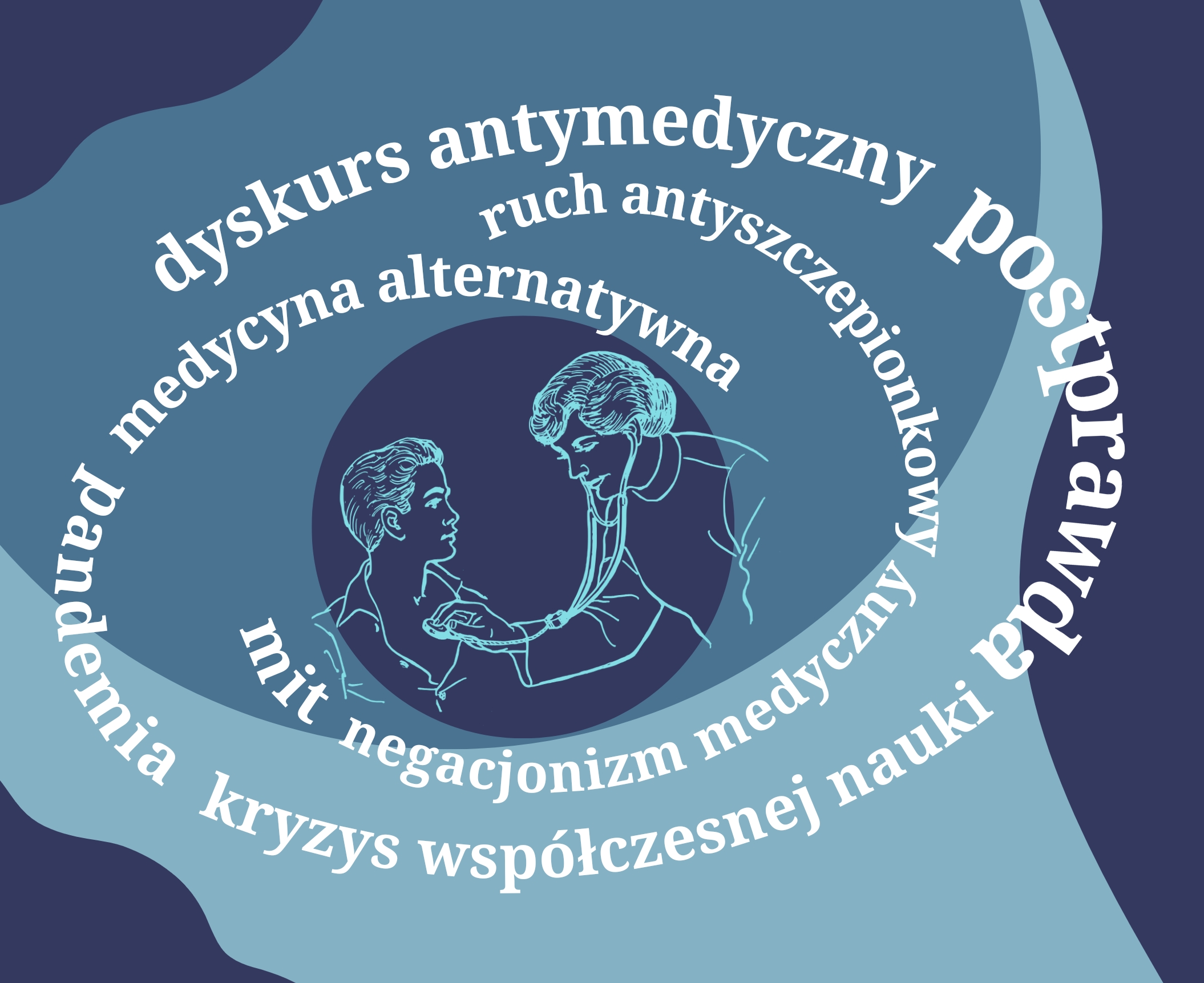
Klaudia Węgrzyn: As befits an ethnologist, anthropologist, and educator, you begin your book with something that could be called autoethnography. Your personal and practical experiences with medicine and the functioning of the healthcare system led to the monograph Mity w świecie postprawdy. O dyskursie antymedycznym (Myths in the World of Post-Truth. On Anti-Medical Discourse) (Wydawnictwo Uniwersytetu Śląskiego, 2025). Were these connections always clear and visible to you?
Ewa Kozik: Although my personal experiences with the healthcare system weren't the only thing motivating me to take up this topic, they certainly constituted an important piece of the puzzle, working in conjunction with other issues. In fact, I was more concerned with the relationships between power and knowledge in the modern world. Listening to opinions about the Polish healthcare system and then experiencing it firsthand, I noticed that from the patient's perspective, data, facts, or clear diagnoses don't matter. Far more important is the way this information is conveyed by doctors. Among my friends, there are people who decide who to trust—a doctor, a pharmacist, or even a quack—not based on what they say, but how they say it. Often, this decision depends on the extent to which a given specialist embodies everything we universally hate about the Polish healthcare system. And this is where this whole post-truth world comes in. The connections you're asking about are, in fact, life itself. We, cultural anthropologists, record and analyze them, whether we're conducting fieldwork or lying in a hospital bed listening to what other patients have to say about doctors. An anthropologist studying contemporary life collects data throughout their lives. Then, they distance themselves from it, describe, analyze, and connect the dots, revealing a world of interdependencies, where there are no "lonely islands" or "free atoms." For an anthropologist, choosing a research topic is a decision about which sphere of their own everyday life they want to explore more deeply.
Klaudia Węgrzyn: The book's title directly announces not only the thematic scope but also suggests a palimpsest. The myths themselves reach incredibly far. Then there are keywords like post-truth and anti-medical discourse. And, of course, the research itself and the conclusions you outline. So, the question is purely technical and organizational: how to manage such a vast amount of material?
Ewa Kozik: That's a difficult question. Especially since I'm not sure I've actually mastered it. However, I think time is key here. Having enough of it to gather data and then having the space to reflect on it, understand its meanings and connections. It's these connections that are truly most helpful. Once you understand what a contemporary myth is, as I write in the book: "the myth of the here and now," it becomes easy to connect the conditions of its formation with the mechanisms of communication occurring online. Virtual space, interpreted as a constant source of information based on emotions rather than facts, leads directly to a world of post-truth. When one phenomenon stems from another, and another conditions another, the researcher's task is to follow this, allowing the described anti-medical discourse to unfold spontaneously. In a sense, this incredible and difficult-to-grasp world organizes itself as we try to convey to the reader what we have managed to perceive within it. Of course, discipline and consistency in collecting and organizing data are essential. They translate into organizing thoughts, and that's worth its weight in gold. However, there's no denying that these are traits that depend on personal predispositions. Despite four years of work on the monograph, I haven't managed to change my chaotic nature. But I had something that, at many points, I practically had to fight for—I had time. This allowed me to collect, describe, and connect all the data.
Klaudia Węgrzyn: The book explores a range of conspiracy theories surrounding medicine. So, you're exploring experiences that, to a greater or lesser extent, affect each of us. The state of the National Health Fund (NFZ) is probably one of the most controversial topics at social gatherings or family gatherings. How do you get to the heart and source of such theories, being in a slightly different information bubble?
Ewa Kozik: Here, it's important to explain the context of fieldwork. Even if conducted online, it requires the anthropologist to transcend their own cultural, social, and in this case, cognitive frameworks. When the research begins, "Ewa" ends, and a researcher enters the scene, teaching the algorithms on the computer and phone new habits. Among the YouTube submissions are supposed to be Jerzy Zięba, wRealu24, and niezalezna.tv, not Marcin Napiórkowski or (dreadful!) Anthony Giddens. If I were to describe content created by people who believe in conspiracy theories, and therefore understand their motivations and why they choose these alternative narratives, I must immerse myself in their linguistic and discursive worldview. I need to feel familiar with their symbolic universe and recognize the connections and dependencies that are obvious to them. Only this gives me the opportunity and the right to write about conspiracy theories, which are a reservoir of knowledge and a source of security for those who believe in them. Fieldwork like this requires stepping outside the spaces that personally provide me with a sense of security in order to understand the group I'm studying. In my opinion, this is an anthropologist's duty.
Klaudia Węgrzyn: Deep diving into a topic naturally carries the risk of overstepping boundaries or pushing your comfort zone. Have you experienced situations where reading something or engaging with a given thread proved too demanding? How do you clear your head after such an intense and immersive experience?
Ewa Kozik: Yes, there were many such situations, and it was particularly difficult for me to collect and analyze data on the alternative television channel wRealu24, which broadcasts content that contradicts not only my knowledge but, above all, my values. Programs distributed by wRealu24 are full of hate speech, racist, anti-feminist, anti-Ukrainian statements—one might even say simply "anti." I researched this medium in 2020 and 2021, during the pandemic and the need to come to terms with isolation, quarantines, and the resulting loneliness. That's when I lost my sense of control and contact with reality; I listened to wRealu24 programs from morning till night. When I recovered, having accumulated a vast amount of research material, the consequences were disastrous. I'm not referring to the personal consequences, because I escaped the trap of fieldwork thanks to the mountains, friends, and travel. I learned the incredibly important importance of mental hygiene. What suffered was my academic development. In 2021, I haven't written a single word, and yet a scientist without publications is like a night without stars. Even if we feel like fledgling scientists at the stage of writing our doctoral dissertation.
Klaudia Węgrzyn: Are the mechanisms governing theories and disinformation in medicine similar to those found in other fields? What areas of our lives are most susceptible to mythologization?
Ewa Kozik: What we're talking about isn't a problem with medicine itself, but with the system we've stopped trusting. I'm referring to the entire system our world is based on—the one in which doctors, pharmacists, and health ministers wield authority based on their knowledge. And here's the fundamental problem. Knowledge acquired at universities, years of research, laboratory experiments, and the risks scientists take to create innovations—that's no longer impressive. It's not politicians or doctors who have lost authority. It's science that has a problem, because in the age of online experts on Tik Tok and celebrities selling supplements, it's simply fallen out of favor. We choose quick and easily digestible knowledge from the internet, which seems more truthful and effective to us because it's tailored to our abilities. That's what the algorithm takes care of, after all. I'm writing about myths because they appear where science fails to adapt to social expectations and loses credibility. Myths will appear wherever research-proven knowledge is undermined by premonitions, beliefs, distrust, and anecdotal evidence that dominate everyday discussions.
I must share my experience of a kind of exclusion that has plagued me since I joined the university. For some of my non-academic friends, the greatest proof that there's no point in listening to what I have to say about medicine is the very fact that I'm a medical anthropologist. This best illustrates the basis on which the modern myths I've described arise. This situation can arise wherever science fails to adapt to the needs of digital natives.
Klaudia Węgrzyn: Where does this strong need to go against the grain, this distrust of science, specialists, data, and statistics, come from in some of us? This question likely touches on the very roots of alternative medicine and its proponents. It's also one of the reasons for the alarming result of the international IPSOS survey, which shows that only 39% of Polish people trust doctors.
Ewa Kozik: First, the main problem here is ignorance. Few people truly understand the work of doctors, especially specialists. The enormous psychological burden—after all, they are responsible for people's lives—combined with the unimaginable amount of knowledge they must acquire throughout their lives impacts how they talk to us, how the system functions, and how they deliver diagnoses. We accuse doctors of lacking empathy, of not understanding what we struggle with, but we rarely consider what a gynecologist, for example, might feel. They have to tell a young woman that she won't be able to have children, inform an elderly woman about probable cancer, and then meet a twenty-year-old who will enter menopause at 25. For each of these women, such news is the end of the world, and this gynecologist must be strong enough to deliver this devastating news. Over time, such a person becomes distant, may seem insensitive, and even hate their job. From the patient's perspective, we simply won't understand. We are therefore faced with an ignorance stemming from the specific role of the doctor in our lives, but also from a simple lack of knowledge about the healthcare system and medicine itself. Although we have the right not to know, the internet and the illusion that we can find information on any topic have conditioned us to act like experts in everything. We feel bewildered because we try to understand complex medical issues, even though we are unprepared. We choose what seems most understandable and consistent with what we already know. However, such content rarely comes from specialists. Thus, we resort to alternative medicine and the knowledge of healers, who deliberately speak to us in a way that reinforces beliefs we "have long held." All of this gives us a sense of control over our lives and health. We regain a sense of security because we find something we can trust.
Klaudia Węgrzyn: Your research efforts are significantly focused on popularizing science and educating others. What do you think are the most effective ways to disarm strong anti-medical positions? Are we considering scenarios that extend beyond the walls of academia, specifically those for whom recognizing and decoding harmful content is not readily available?
Ewa Kozik: In my opinion, the most effective way to disarm strong anti-medical attitudes is to combine trust-based education with transparent communication. This isn't about confrontation or correcting errors in an aggressive way, but building a relationship in which the recipient feels they're dealing with a credible source. The key is to translate complex medical facts into everyday language. Instead of using specialized jargon, simple analogies and examples should be used. It's also important to demonstrate that science isn't dogma but an ongoing process, and its conclusions can evolve as new research emerges. Instead of attacking anti-medical beliefs, it's better to try to understand the underlying causes. People often trust pseudoscience because they feel neglected by the healthcare system or are terrified of illness. Engaging in empathetic dialogue, asking questions, and listening instead of prescriptive "truths" can open the door to a shift in perspective. Such empathetic and understanding action should be the norm, occurring everywhere, including in the university setting, because we are all susceptible to doubt, and even scientists' beliefs can become myths. It's also crucial to educate doctors themselves and promote humanistic medicine, which focuses not only on treating illnesses but also on a holistic approach to the patient as a person. We must introduce dialogue into the doctor-patient relationship, so that medical knowledge connects with the patient's life situation, and diagnoses aren't delivered in isolation from their experiences. Equally important is educating patients about the challenges doctors face and how the healthcare system functions. Understanding that medical personnel work under enormous pressure, often under conditions of limited time and resources, can help build mutual respect and empathy. Demonstrating that doctors are human beings with their own limitations can reduce distance and facilitate dialogue, which in turn will translate into greater trust.
Klaudia Węgrzyn: In your monograph, you reference pop culture: you write about the series Grey's Anatomy and Dr. House, citing viral infographics and memes, but above all, you deep dive into the practices of powerful media personalities and portals such as Jerzy Zięba, Jerzy Jaśkowski, and wRealu24. What are your most important conclusions about the influence of post-truth and unregulated media channels on the creation of large amounts of disinformation and myths?
Ewa Kozik: Pop culture, from medical dramas to memes, provides a crucial backdrop for the post-truth phenomenon, but the real challenge comes from unregulated media channels and powerful personalities who deliberately exploit this chaos to spread disinformation. My key conclusions focus on several key mechanisms that allow them to gain and maintain their enormous influence. Influencers like Jerzy Zięba and Jerzy Jaśkowski often don't rely on hard data or scientific research. Instead, they build their credibility on personal stories, anecdotes, and testimonies. Their narratives are relatable and emotional, which makes them resonate much more deeply than cold, scientific facts. In this way, they gain the trust that traditional medicine often loses due to its rigidity and formal language.
These types of media channels create an image of excluded heroes who have "unraveled" the conspiracy of the establishment, pharmaceutical corporations, and "bad" medicine. They appeal to a widespread sense of injustice and distrust of institutions. They offer simple answers to complex problems and promise "natural" solutions that are "hidden" from ordinary people. This gives audiences a sense of belonging to an elite circle of insiders, further strengthening their loyalty. The most important conclusion is that in a post-truth world, belief in disinformation is becoming a part of identity. Rejecting traditional medicine is no longer just a matter of choosing a treatment method, but an expression of opposition to a system, ideology, or lifestyle. People defend their beliefs not because they are based on facts, but because they constitute a key part of who they are. Changing their views would mean losing their integrity, which is why it is so difficult to "disarm" these deeply ingrained attitudes.
Klaudia Węgrzyn: These media palimpsests are currently being overlaid with another layer: artificial intelligence. Have you noticed any significant changes in its presence in the medical field while working on this topic? It seems that AI's power to break through into the mainstream is gaining momentum and proficiency not just month by month, but day by day. With an online archive and reservoir of unverified content at its disposal, it can begin to create—or is already creating—some truly compelling and potentially devastating content.
Ewa Kozik: When I finished writing this article, AI was just emerging, so I didn't have the opportunity to compare my research results with how AI works today, especially since, as has been said, AI changes almost by the minute, learning, transforming, and creating new behaviors online. However, I realize that AI, with its vast archive of data, including unverified content, learns to create narratives that are incredibly persuasive and mimic the style of credible sources. By leveraging what worked for figures like Jerzy Zięba, AI can generate personalized, emotional content that resonates with audiences. Furthermore, AI not only replicates false information but often expands and enhances it by adding scientific language or false quotes. This creates an illusion of reliability that is nearly impossible for the average user to debunk. Unlike a human disinformer, who has limited resources, AI can operate on a massive scale, creating thousands of variations of the same disinformation. This threat is twofold. On the one hand, there are threats to patients who, seeking medical advice from chatbots or unverified websites, may receive false diagnoses or advice, which in turn can have tragic consequences. AI could further contaminate the digital archive of knowledge, making it more difficult in the future to distinguish truth from falsehood, even for professionals. This phenomenon is no longer potential—it's already happening, and its scale is growing daily.
 Publication created as part of the project „Polonistyka wobec wyzwań współczesnego świata” ["Polish Studies in the face of the challenges of the contemporary world"], co-financed by the state budget under the program of the Minister of Science and Higher Education called "Science for Society II" (project number: NdS-II/SP/0264/2024/01).
Information
Afiliacja: Szkoła Doktorska, Wydział Humanistyczny, Uniwersytet Śląski w Katowicach
Udział w projektach:
- od 2024: Polonistyka wobec wyzwań współczesnego świata;
- Edycja krytyczna listów i archiwalnych materiałów piśmiennych więźniów obozów koncentracyjnych (Stutthof, Gross-Rosen, Auschwitz);
- 2018-2019: Światowa historia literatury polskiej. Interpretacje (Narodowy Program Rozwoju Humanistyki); Traces. Awkward Objects of Genocide (European Union’s Horizon 2020)
Witryny:
https://silesian.academia.edu/klaudiawegrzyn
https://klaudiakwegrzyn.wixsite.com/portfolio
Publikacje (wybrane):
- Pamięć (za)chowana w ciele. Prześnione powroty w "Pogrzebie kartofla" , "The Polish Journal of the Arts and Culture. New Series" 14 (2/2021);
- (Auto)portret w pękniętym zwierciadle. Czuła narracja, trauma i podmiotowość w czarnej komedii "Kidding", w: Artyst(k)a: czuły narrator. Wcielenia oraz interpretacje czwartoosobowej perspektywy w tekstach kultury, red. M. Popiel, K. Węgrzyn, Kraków 2021;
- Kant by się uśmiał, czyli co łączy amerykański sitcom z filozofią moralności i etyką, w: Komizm w kulturze popularnej. Funkcje, interpretacje, kontrowersje, red. D. Ciesielska, M. Kozyra, A. Łozińska, Kraków 2020;
- Archeologia antyfotografii. Wywoływanie zdjęć i widm z Sanoka w pracach Jerzego Lewczyńskiego oraz Zdzisława Beksińskiego, w: Pamięć, obraz, projekcja, red. A. Ścibior, Kraków 2020;
- (S)przeciw milczeniu. Tabu, sieroctwo i dorastanie w serialowej adaptacji "Ani z Zielonego Wzgórza" , “Maska” 41/2019
- Inna strona. Wizualność i wizualizacja obcości w filmach Jana Jakuba Kolskiego, w: Inność? Obcość? Norma?, red. K. Zakrzewska, Warszawa 2018;
- Teatralne prymicje czarownicy z Krakowa. Rozkwitający feminizm w wybranych dramatach Pawlikowskiej-Jasnorzewskiej, "Zagadnienia Rodzajów Literackich" 60/122 2017;
- Gest autobiograficzny. Okrutny teatr fotografii Zdzisława Beksińskiego, "Widok. Teorie i praktyki kultury wizualnej" 12/2015.
Zainteresowania badawcze:
analiza mitów współczesnych na temat zdrowia i medycyny (z perspektywy socjologii wiedzy i antropologii filozoficznej), percepcja kultur bliskowschodnich oraz kultur Azji Południowo-Wschodniej, religijność ludowa, teorie spiskowe i fake newsy.
Wybrane publikacje:
- Mity w świecie postprawdy. O dyskursie antymedycznym, Katowice 2025, DOI: https://doi.org/10.31261/PN.4244,
- Postawy antyuchodźcze uczestników social mediów a cele edukacji międzykulturowej, "Edukacja Międzykulturowa" 2023, nr 2, s. 28-40. DOI:10.15804/em.2023.02.02,
- Jak troszczyć się o życie?: antyszczepionkowe narracje spiskowe w czasie pandemii COVID-19, "Studia Etnologiczne i Antropologiczne" 2021, vol. 21, nr 1, s. 1-19. DOI:10.31261/SEIA.2021.21.01.02,
- Dyskurs nienawiści i jego wpływ na kształtowanie się postaw ksenofobicznych: na przykładzie Polski, w: Contemporary trends shaping the global world: collection of the scientific materials, Uniwersytet Warmińsko-Mazurski, Olsztyn 2021, s. 232-242,
- Hagiografia w wydaniu ludowym – postaci świętych w XIX-wiecznej literaturze dla ludu, w: „Przed ołtarzem pól…” święci w kulturze ludowej, Uniwersytet Marii Curie-Skłodowskiej, Lublin 2021, s. 15-24.
Przynależność do towarzystw naukowych:
- Polskie Towarzystwo Ludoznawcze (Oddział w Cieszynie),
- Towarzystwo Naukowe im. Stanisława Andreskiego w Krakowie,
- Międzynarodowa Sekcja Sztuki Ludowej (IOV) – Sekcja Polska.
https://orcid.org/0000-0003-1129-0536
https://www.researchgate.net/profile/Ewa-Kozik
Ewa Kozik - Google Scholar
Zob. także:
Podcast | O etnologii i antropologii kulturowej | dr Ewa Kozik | Uniwersytet Śląski w Katowicach - rozmowa Tomasza Grząślewicza z dr Ewą Kozik, nagrana z okazji Ogólnopolskiego Dnia Etnografii, Etnologii i Antropologii Kulturowej (9 lutego). Odcinek podcastu został zrealizowany przez pracowników Centrum Komunikacji Medialnej UŚ w ramach cyklu Przystanek Nauka.
See also
Priceless testimonies of the landscape, or environmental literary history in practice (part 2)
Klaudia Węgrzyn talks to Dr. Marcin Buczyński, the initiating editor of the University of Silesia Publishing House.
A Rocker Professor
A graduate of Polish studies at the Faculty of Humanities of the University of Zielona Góra. Used to be a presenter at Radio Zielona Góra, and now she is a professor at the University of Zielona Góra as well as the head of the Journalism Laboratory and a member of the Polish Linguistic Society. Here come the many faces of Professor Magdalena Steciąg, Phd DSc.
Interview with Prof. Anna Frajlich, Senior Lecturer, Emerita of the Department of Slavic Languages at Columbia University
Professor Anna Frajlich, a renowned poet with impressive dossier of achievements, who left Poland in 1969 because of the anti-Semitic campaign, has lived in New York for years. Here, at the Slavic Studies Department of New York University, she defended her doctoral thesis on the legacy of ancient Rome in the Silver Age of Russian Poetry, and for 34 years, from 1982 to 2016, she was a lecturer at the Slavic Studies Department of Columbia University. Currently, retired for eight years, she continues to actively participate in American and Polish literary life, taking part in meetings, conferences, and talks. One of them was conducted by Przemysław Górecki in the New York apartment of the professor and her husband.
Art in the Places of Death. An interview with Prof. Halina Taborska
"Halina Taborska's book (...) is a peculiar study of the aesthetics of an anti-humanistic act. In fact it introduces such "aesthetics" to the readers, and we are presented with a very carefully prepared documentation of various objects, material and spatial shapes, "installations", murals, museum organizations and documentary activities. These are various shapes in the public space which mediate our perception of an unimaginable crime or "blinding” shapes that protect us from the damages of seeing it again. By bringing this collection of practices together, the book shows their character and multiplicity. The research material gathered in the publication and the scholarly approach make it a must-read not only in the study of war crimes in Europe, but also in the study of symbolic representation of mass crimes - especially in the field of cultural studies, cultural anthropology and art history.” (Prof. Jan Stanisław Wojciechowski, Academy of Fine Arts in Warsaw - excerpt from the review on the cover).