Wydarzenie
NARRATING JUSTICE: POSTWAR TRIALS IN MEMORY AND CULTURE
The year 2026, marking the eightieth anniversary of the Nuremberg Trials (1945–1946), invites renewed reflection on the significance of post-war justice in the longue durée of twentieth-century European history.
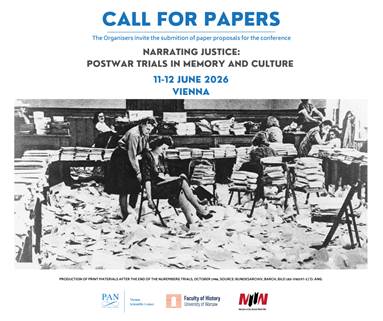
As the foundational moment of an era of reckoning with totalitarianism, the trials initiated a complex and multi-phase process of legal, moral, and cultural confrontation with the legacy of war crimes. This process extended well beyond the 1940s, unfolding over subsequent decades, from high-profile trials in West Germany to belated reckonings in Austria and other European states.
Public engagement elevated the trials beyond their legal framework, turning them into sites of social and cultural meaning. Reported by the press, radio, and later television, they generated enormous public interest, influenced the perception of history, and co-created narratives about guilt, responsibility, victims and perpetrators. Over time, they became an important reference for artistic and creative expressions, manifested in diverse forms and practices engaging with memory.
The discussion on post-war reckoning provides an opportunity to reflect on contemporary responses to violence and human rights violations, as well as on the role of scholarly research in the face of current conflicts and growing political tensions in Europe and around the world. The conference seeks to examine post-war trials as a long-term historical, legal, social and cultural phenomenon.
Drawing on approaches from different fields of scholarship, it will address the immediate post-1945 tribunals and their aftermath, as well as later trials and broader processes of post-conflict justice in diverse contexts. Attention will be given to the historical, social, and media
contexts of these trials, their forms of documentation and reception, as well as their representation in literature, film, theatre, music, and the visual arts. We also invite contributions focusing on non-European contexts, perspectives, and historical settings.
We invite abstracts covering topics that include, but are not limited to:
- Historical and Legal Contexts: The Nuremberg Trials and their impact on the development of international criminal law; Trials in Germany, Austria, Poland, and other countries; Shifts in legal categories: from war crimes to crimes against humanity
- Social and Political Dimensions: Reception of post‑war trials in European societies; Public debates on guilt, responsibility, and retribution; The role of victims’ and witnesses’ testimonies
- Trials in the Media: Press, radio, television, and digital coverage of trials, Documentary recordings as historical sources, Visual and rhetorical strategies in depicting perpetrators and victims
- Cultural and Artistic Representations: Trials as motifs in literature, theatre, film, and the visual arts; Artistic reconstructions, reinterpretations, and revisitations; Documentary literature and nonfiction in the context of legal history
- Memory Studies and Politics of Memory: Post‑war trials in European cultural memory; Transnational and comparative perspectives; Institutionalization of the memory of trials (museums, archives, education)
- Contemporary Relevance: Continuities between post‑war tribunals and modern international courts; Narratives of responsibility in the context of contemporary conflicts; Challenges for law, memory, and justice in the twenty‑first century
TIMELINE AND SUBMISSIONS
Proposals must include, in a single PDF file:
1) paper abstract (max. 1,000 words)
2) brief biography of the author(s)
All conference submissions must be in English, and all accepted works are to be presented in English. Proposals for the conference should be submitted to office@vienna.pan.pl by March 22, 2026.
ACCOMODATION AND TRAVEL
The conference will take place over two days, on 11–12 June 2026, at the Polish Academy of Sciences – Scientific Centre in Vienna (Boerhaavegasse 25, 1030 Vienna).
The organisers encourage in-person participation by all speakers. However, depending on the circumstances, some presentations could be delivered online. Please note that invited speakers will be responsible for their transport to and from Vienna.
Participation in the conference is free of charge, and participants will be offered lunch and coffee during the breaks. Participants without institutional support may receive reimbursement of travel expenses up to €150 per person, as well as modest complimentary accommodation at the PAS Scientific Centre in Vienna. For those requesting support, a brief statement of purpose (500–650
words) should be submitted with the abstract and biography.
Inquiries can be made by e-mail to monika.gromala@vienna.pan.pl, milena.blahuta@vienna.pan.pl
Informacje
Zobacz także
Transformations of Shoah Trauma in Post-2000 Literatures
In the eighty years since the end of the Second World War, perspectives on the Shoah have evolved significantly, shaped by geopolitical and social factors. ese shifts have encompassed periods of silence, an inability or unwillingness to process the catastrophe´s exceptional scale, and movements toward visibility, fascination, marginalization, denial, privatization, instrumentalization and commercialization. As historical distance grows, new generations of writers, artists, and scholars face the challenge of representing this trauma in ways that engage contemporary audiences while remaining anchored in historical memory.
Memory Studies Association Annual Conference “Convergences”
We welcome proposals for papers, panels, and other events to be presented at the Memory Studies Association’s 2021 annual meeting. As always, the MSA will be a forum for debating all aspects of memory studies.
Traumatic Modernities: From Comparative Literature to Medical Humanities / International Conference and Seminars
Organizers:
Literature in Exile Between ‘Authorship’ and ‘Translation’: The Central and Eastern European Experience
This conference aims to examine the complex relationship between ‘authorship’ and ‘translation’ in the work of the 20th-century Central and Eastern European writers in exile who were also translators. In the context of the reassessment of ‘literariness’ in the latter half of the 20th century, the conference is particularly focused on the overlapping relationship between both these concepts, which are seen as interrelated, historically variable categories of literary creativity of exiled writers in redefining themselves against the nationalist narratives. The workshop will thus contribute to the discussion on cultural translation and post-national literature in general.